A Small Test Document for TeX→HTML Pipelines
2026-10-12
Abstract
This document is designed to test a TeX-to-HTML/EPUB pipeline. It includes sections, theorem environments, references, equations, tables, a TikZ diagram, and some common edge cases (long formulas, inline math, lists).
Overview
We treat mathematics as a language for structure. Inline math looks like $a^2+b^2=c^2$, and display math is used for longer expressions.
We will refer to Definition~def:random-variable and Theorem~thm:chebyshev. We also test hyperlinks: GitHub profile.
A long formula (line breaking)
Below is a long inequality. Use align to allow automatic line breaks:
Core objects
Definition
A random variable is a function $X:\Omega→ \R$ defined on a sample space $\Omega$. Its expectation is \[\E[X] := \int_\Omega X(\omega) d\Prb(\omega),\] when the integral is well-defined.
Example
Let $X\in\{0,1\}$ with $\Prb(X=1)=p$ and $\Prb(X=0)=1-p$. Then $\E[X]=p$ and $\Var(X)=p(1-p)$.
A theorem and proof
Theorem
Let $X$ be a random variable with finite mean $\mu=\E[X]$ and finite variance $\sigma^2=\Var(X)$. Then for any $t\gt 0$, \[\Prb(|X-\mu|\ge t)\le \frac{\sigma^2}{t^2}.\]
Proof
By Markov's inequality applied to the nonnegative random variable $(X-\mu)^2$, \[\Prb\bigl((X-\mu)^2\ge t^2\bigr)\le \frac{\E[(X-\mu)^2]}{t^2} =\frac{\Var(X)}{t^2}.\]
Remark
This is a good test of theorem/proof rendering as a block component.
Lists and small layout features
Enumerations
- Inline math inside text: $f(x)=x^2$.
- A displayed equation: \[\int_0^1 x^2 dx=\frac{1}{3}.\]
- A reference test: Equation~(eq:long).
A table (booktabs)
Table~tab:complexity tests alignment and rule rendering.
| Method | Time (ms) | Notes |
| Finite differences | 12.4 | baseline |
| WENO (order 5) | 48.0 | sharper shocks |
| Integer flux (FQNM-style) | 9.1 | structure-preserving |
TikZ diagram
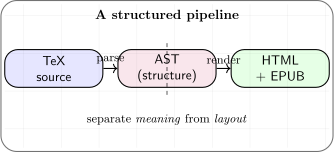
Figure~fig:tikz tests TikZ-to-SVG export with named nodes, styles, and labels.
Footnote and link tests
A footnote test.* Another link: https://lapl.asia.
Conclusion
We tested: sections, references, long equations, theorem/proof blocks, lists, tables, TikZ, and footnotes. If the HTML output preserves structure (not just pixels), the pipeline is doing the right thing.